

Fiber Housings Frequently Asked Questions
+ What is the benefit of HighSTACK™ High-Density housings for SmartRIBBON™ splicing?
Our HighSTACK™ housings are engineered specifically for high-core count environments, supporting up to 576 fibers in a 4RU chassis. By optimizing the internal tray depth and routing for SmartRIBBON™ mass fusion splicing, these units allow technicians to manage high-density ribbon cables with significantly reduced installation time and superior organization compared to standard splice trays.
+ How does the modular housing system support mixed technology in a single chassis?
The primary advantage of our modular housings is flexibility. Within a single 1RU to 4RU chassis, you can mix various technologies—such as MPO-to-LC fanout cassettes for patching alongside MPO pass-through adapter panels for trunking. This allows you to support legacy hardware and high-speed 400G migrations simultaneously without needing separate enclosures.
+ What is the difference between standard density and high-density fiber housings?
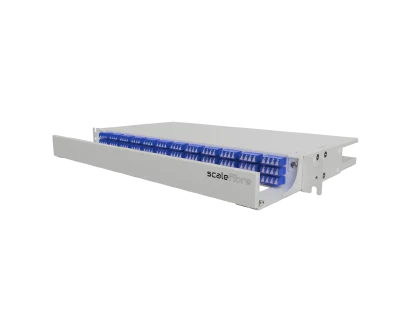
Standard density housings typically support up to 72 fibers per 1RU and are designed for traditional patching and single-fiber splicing. In contrast, high-density (HD) housings utilize telescoping trays and modular cassettes to achieve double or quadruple that capacity (up to 144f per 1RU), making them the preferred choice for data centers and hyperscale central offices.
+ Can I use both single-fiber and ribbon-fiber in the same housing?
Yes. Our standard and modular housings are designed with versatile cable management that accommodates both single-fiber patching and ribbon-fiber splicing. For dedicated ribbon projects, the HighSTACK™ series is recommended to better manage the larger bend radius and specific tray requirements of mass fusion sleeves.
+ Are the modular cassettes compatible with MPO and MTP standards?
Absolutely. Our modular cassettes are designed for seamless integration with MPO and MTP® trunk cables. These cassettes typically feature rear-facing MPO adapters that fan out to front-facing LC or SC ports, ensuring low-loss performance and correct polarity management across your entire optical link.
+ What features should I look for in an outdoor FTTH access housing?
For outdoor FTTH (Fiber to the Home) applications, the housing must have at least an IP65 or IP68 rating to protect against moisture and dust. Key features include UV-resistant materials, integrated PLC splitter mounting brackets, and secure drop-cable entry points to ensure reliable ’last-mile’ connectivity in harsh environmental conditions.
+ Do your wall mount housings support indoor security and access control?
Yes, our indoor wall mount housings feature lockable front doors and ruggedized entry points to prevent unauthorized access. They are ideal for building entrance facilities or telco closets where space is at a premium but physical security of the fiber terminations is a priority.
+ What configurations are available for high-capacity fiber deployments?
We offer a range of scalable chassis sizes to fit any rack profile: 1RU (up to 144f), 2RU (up to 288f), and 4RU (up to 576f). Each size is designed with sliding drawers and front/rear access to ensure that even at maximum density, technicians can perform maintenance without disturbing adjacent live circuits.