MPO Trunks and Fanouts

MPO Trunks and fanouts in small, medium and high fiber counts.

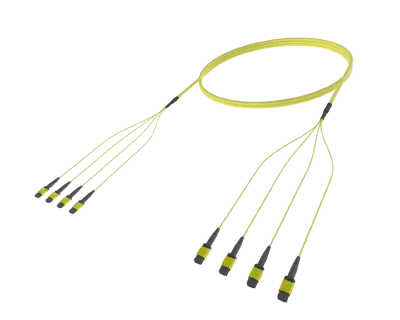
MPO Fanout Cable Assemblies

MPO to LC fanout assemblies in single-mode and multi-mode. Factory-tested, compact, and ideal for breaking out high-density MPO backbones to switch or server ports.

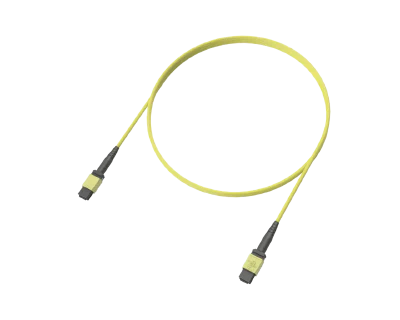
Small Fiber Count MPO Trunk Cables

High-density MPO trunk cables with 8 to 24 fibers. Compact, factory-tested, and ideal for short-run backbone and patching in enterprise or edge networks.

Medium Fiber Count MPO Trunk Cables

Medium fiber-count MPO trunk assemblies with 36 to 144 fibers. Enables fast, large-scale deployment with reduced labour and minimal installation overheads.

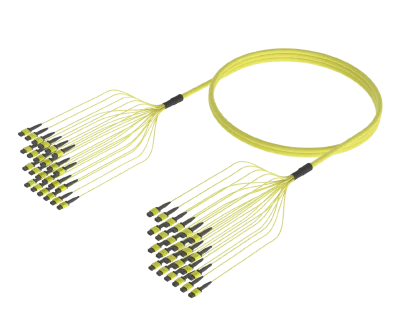
High Fiber Count MPO Trunk Cables

High-count MPO trunk cable up to 288 fibers. Compact, lightweight, and perfect for backbone installs in hyperscale or enterprise datacentre.

MPO Trunks and Fanouts Frequently Asked Questions

+ What is the difference between MPO and MTP® connectors?
MPO (Multi-fiber Push-On) is the general industry standard for multi-fiber connectivity. MTP® is a specific brand of MPO connector manufactured by US Conec that is optimized for high-performance applications. Both are fully compatible; however, the real difference lies in the build quality. At ScaleFibre, we prioritize network reliability by using only premium-grade MPO components from industry leaders, including US Conec and Senko. By utilizing high-precision ferrules and superior housing materials, our assemblies ensure stable, low-loss connections for critical 400G and 800G data center links.

+ What is the difference between an MPO trunk and an MPO fanout cable?
An MPO trunk cable features MPO connectors at both ends and acts as the ‘backbone’ for high-density permanent links between patch panels. In contrast, an MPO fanout assembly (or breakout cable) transitions from a single MPO connector to multiple individual connectors (like LC or SC). This allows a high-speed parallel optic port (e.g., 40G/100G) to connect directly to multiple lower-speed duplex ports, maximizing switch port utilization.
+ Which MPO cables are required for NVIDIA DGX and InfiniBand clusters?
High-performance AI clusters require specialized connectivity. We offer MPO 1:2 Splitter Cables specifically designed for NDR InfiniBand and Spectrum Ethernet. These cables feature the bespoke polarity and ultra-low-loss performance (APC) required to support 200G/400G and 800G twin-port OSFP transceivers, ensuring seamless integration with NVIDIA Quantum-2 switch architectures.
+ What are the benefits of using high fiber count MPO trunks (up to 144 fibers)?
High fiber count MPO trunks are engineered to reduce cable bulk and improve airflow in congested data center pathways. By consolidating up to 144 fibers into a single micro-core jacket, you significantly reduce tray occupancy compared to multiple smaller cables. This ‘single-pull’ installation method lowers labor costs and simplifies management in hyperscale spine-leaf architectures.
+ Why is MPO polarity (Type A, B, or C) critical for my installation?
Polarity defines the mapping of transmit (Tx) and receive (Rx) signals. ScaleFibre assemblies are available in Method B (Reversed), the industry standard for 40G/100G parallel optics, as it naturally aligns Tx to Rx. We also provide Method A (Straight-through) and Method C (Pair-flipped) to match legacy infrastructure or specific modular cassette requirements. Using the incorrect polarity will result in a complete link failure.
+ Should I choose Male (Pinned) or Female (Unpinned) MPO connectors?
MPO connections always require one Male (with pins) and one Female (without pins) connector to ensure precise alignment. Typically, MPO trunk cables are Female-to-Female to protect the pins during installation, while the transceivers and patch panel cassettes feature Male ports. However, our Small Fiber Count Trunks can be customized with pinned connectors for direct switch-to-switch links.
+ What performance advantage does the APC polish provide on MPO connectors?
Our NVIDIA-compatible MPO patch cables utilize an APC (Angled Physical Contact) 8-degree polish. This reflects back-reflection light into the cladding, achieving a much higher return loss (>60dB). This is essential for high-speed single-mode systems and PAM4 modulation used in 400G/800G networks, where signal-to-noise ratios are extremely tight.